

If you’re new to out-of-home (OOH) advertising, you’ve probably come across terms like DOOH, Billboard, SOV, CPM, Reach, Frequency, and Programmatic DOOH, making it difficult to read proposals or communicate with agencies.
This article compiles the most common OOH terminology, organized into categories to help marketers, businesses, and communications beginners understand the industry more easily.
1. Basic OOH Terminology
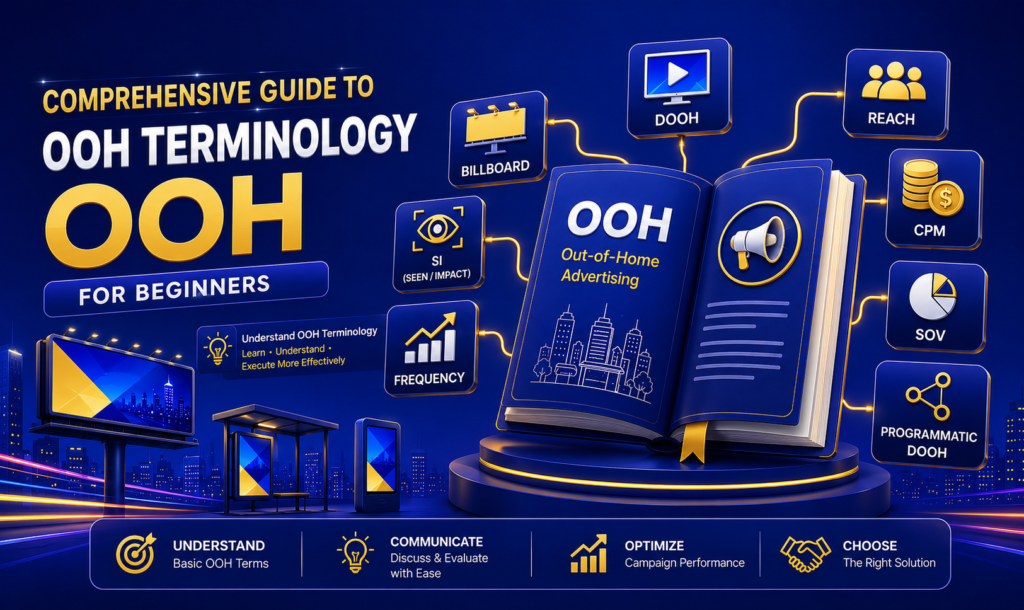
OOH (Out-of-Home Advertising)
A form of advertising that reaches consumers while they are outside their homes. OOH includes various formats such as billboards, LED screens, airport advertising, Metro advertising, buses, taxis, and bus shelters.
DOOH (Digital Out-of-Home)
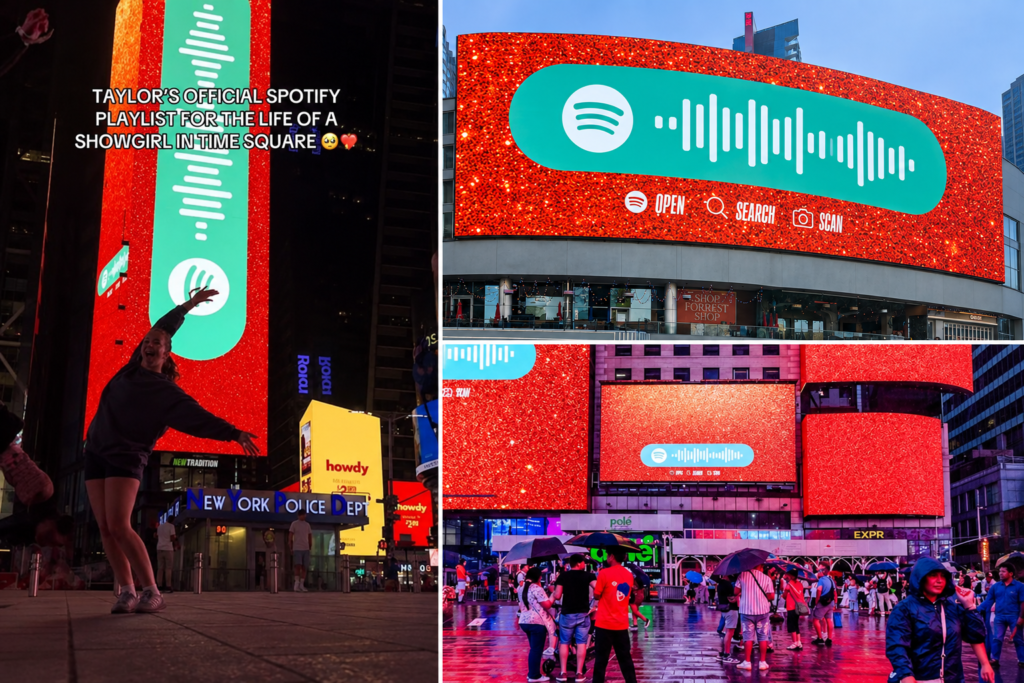
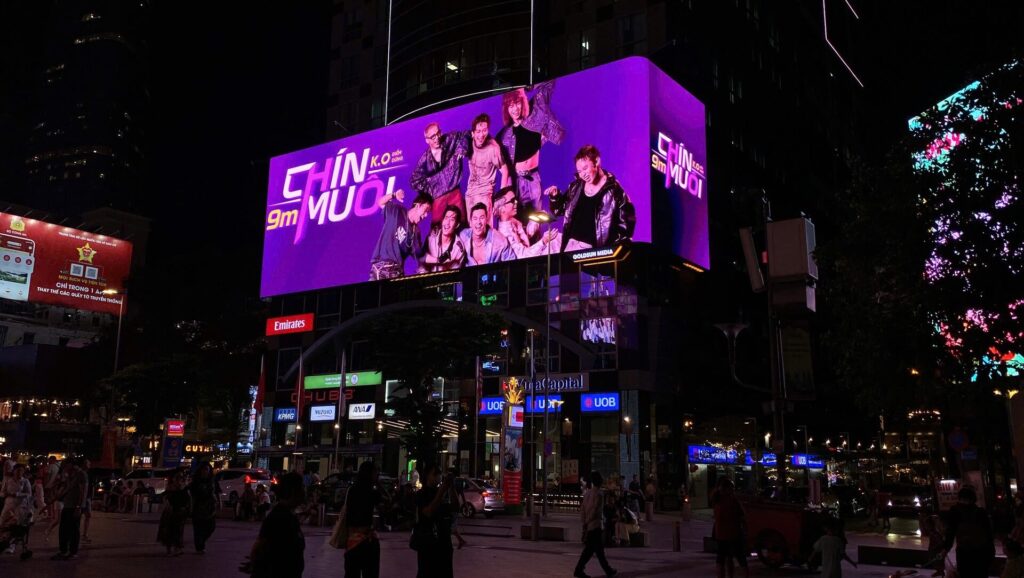
DOOH (Digital Out-of-Home) is a form of digital outdoor advertising that uses LED or LCD screens to display content, replacing traditional static printed billboards.
Powered by digital technology, DOOH enables advertisers to remotely update content, display multiple advertisements on a single screen, schedule playback by time of day or audience context, and manage campaigns more efficiently.
In addition, DOOH can integrate data, AI, and intelligent management platforms to optimize campaign performance in real time. With its flexibility, personalization capabilities, and increasingly advanced measurement solutions, DOOH has become one of the fastest-growing trends and a key driver of transformation in the global out-of-home advertising industry.
Static OOH or Classic OOH
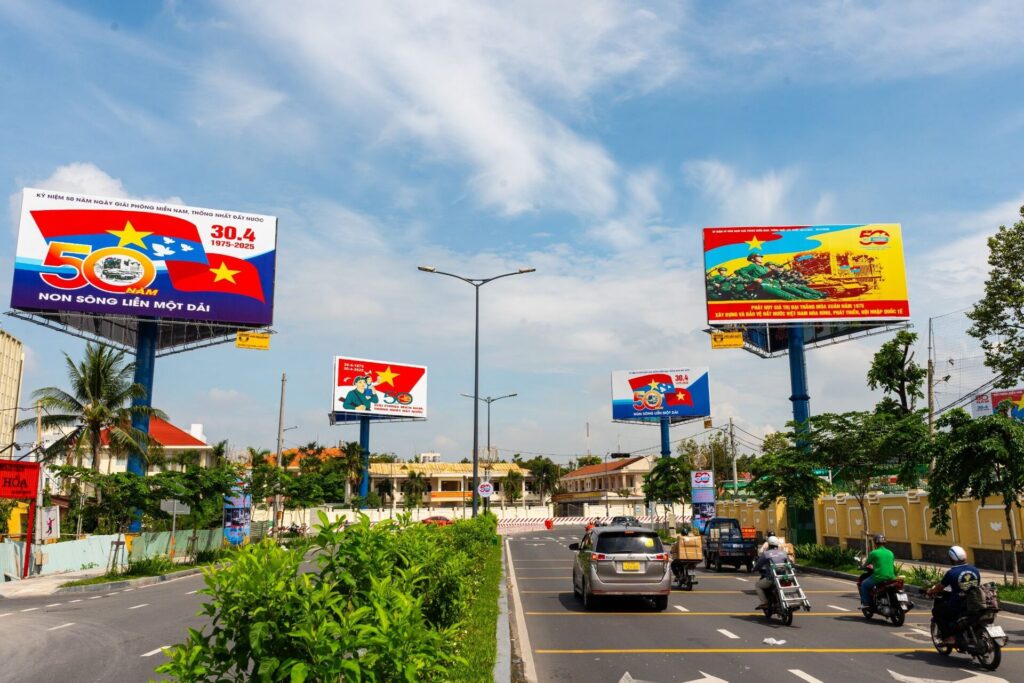
Static or Classic Out-of-Home refers to traditional outdoor advertising using fixed printed media, including Hiflex billboards, pano signs, posters, wall paintings, and similar formats.
Unlike DOOH (Digital Out-of-Home), the content of Static/Classic OOH is printed and installed once and cannot be changed throughout the campaign period. Thanks to its ability to maintain consistent messaging over an extended period, it remains a suitable choice for campaigns focused on broad reach and long-term brand awareness.
2. Advertising Format Terminology
Billboard
A large-format advertising structure placed along high-traffic roads. It is one of the most common OOH advertising formats today.
Pano
Typically refers to large-format advertising structures installed on building facades or at city gateways. In Vietnam, the terms Billboard and Pano are sometimes used interchangeably.
LED Billboard
An LED Billboard uses an LED display instead of a traditional printed vinyl billboard. This format allows advertisers to display videos, update content remotely in real time, and showcase multiple brands on the same screen, providing greater flexibility and cost efficiency for DOOH campaigns.
Airport Advertising
Airport Advertising includes LED screens, Lightboxes, LCD displays, banners, sampling activities, and brand activations within airports. This OOH channel effectively reaches high-income consumers, business travelers, and tourists, making it ideal for brands seeking premium visibility and strong brand positioning.
Transit Advertising
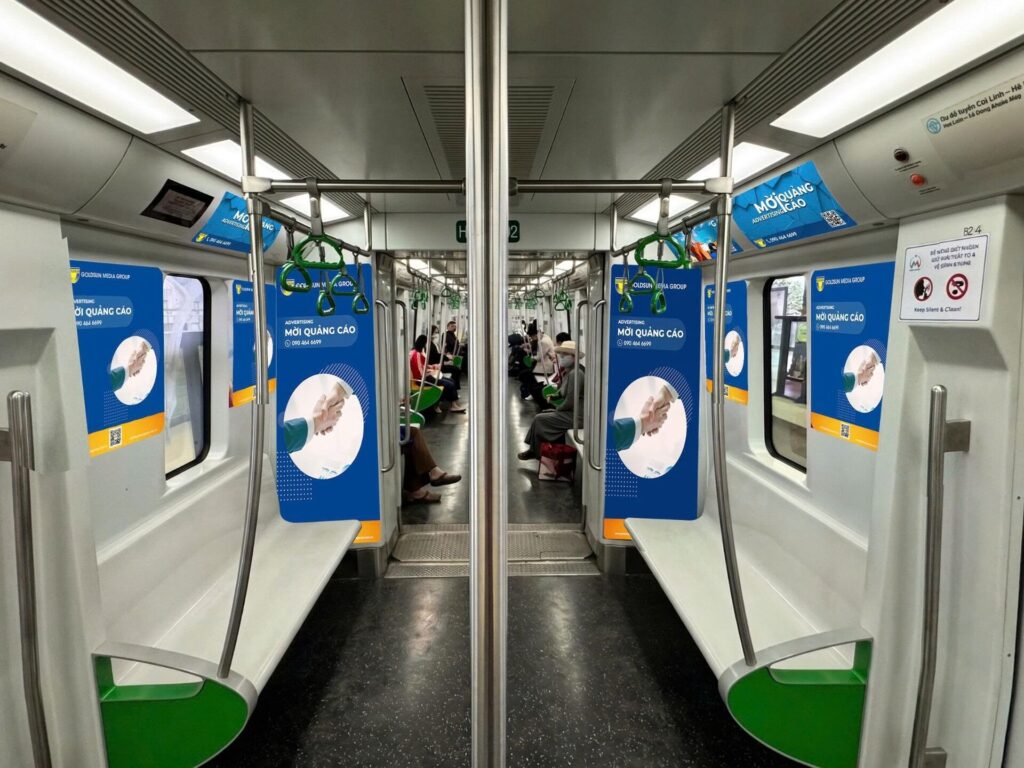
Transit Advertising refers to advertising on public transportation systems and infrastructure, including Metro trains, buses, taxis, railway stations, and bus shelters. This format enables brands to reach consumers throughout their daily journeys with high message repetition, effectively strengthening brand awareness.
Street Furniture
Street Furniture advertising includes media placements on urban infrastructure such as bus shelters, information kiosks, benches, and street kiosks. This format allows brands to naturally and consistently engage pedestrians and commuters in public spaces.
3. Campaign Measurement Terminology
Reach
The number of people exposed to a campaign. The greater the reach, the higher the potential for building brand awareness.
Frequency
The average number of times an individual sees an advertisement. In OOH, Frequency plays a critical role because brand recall is often built through repeated exposure.
Impression
A single instance in which an advertisement is displayed to viewers. In OOH, impressions are typically estimated based on traffic volume and mobility patterns.
OTS (Opportunity To See)
A metric that measures the likelihood of a person having the opportunity to see an advertisement while passing its location. OTS does not confirm that the viewer actually looked at the advertisement; it only reflects the opportunity for exposure. It is one of the traditional metrics used in the OOH industry.
SI (Seen/Impact Score)
Seen/Impact Score is a new measurement model that uses Eye-tracking and EEG technology to evaluate the effectiveness of outdoor advertising.
SI consists of two measurement categories:
- Seen: Whether the advertisement is actually seen.
- Impact: How effectively the advertisement generates attention, emotion, and memory.
It is considered a new direction in measuring DOOH campaign effectiveness.
CPM (Cost Per Mille)
The cost of delivering 1,000 impressions. CPM is commonly used to compare investment efficiency across different media channels.
4. Display Terminology
| Term | Definition | Example / Meaning |
| SOV (Share of Voice) | The percentage of advertising airtime allocated to a brand on the same LED screen. | If a screen displays ads from 10 brands and each brand accounts for 10% of the airtime, each brand has a 10% SOV. The higher the SOV, the greater the frequency of exposure, helping increase brand recall. |
| Loop | One complete playback cycle of the entire advertising playlist on an LED screen. | For example, a 120-second loop means the entire playlist is played and repeated every 2 minutes. |
| Spot | One playback of an advertising creative on a screen. | For example, a 15-second advertising video played once is counted as 1 spot. |
| Playtime | The period during which an LED screen is operational and displays advertisements during the day. | For example, a screen operates from 06:00 to 22:00. This is the period during which ads are played according to the scheduled playlist. |
| Prime Time | The time period with the highest audience traffic, delivering greater media impact. | The time period with the highest audience traffic and communication effectiveness. Example: 07:00–09:00 (morning rush hour) and 17:00–19:00 (evening rush hour). Many brands increase SOV or playback frequency during these hours to maximize reach. |
5. DOOH Technology Terminology
Dynamic Content
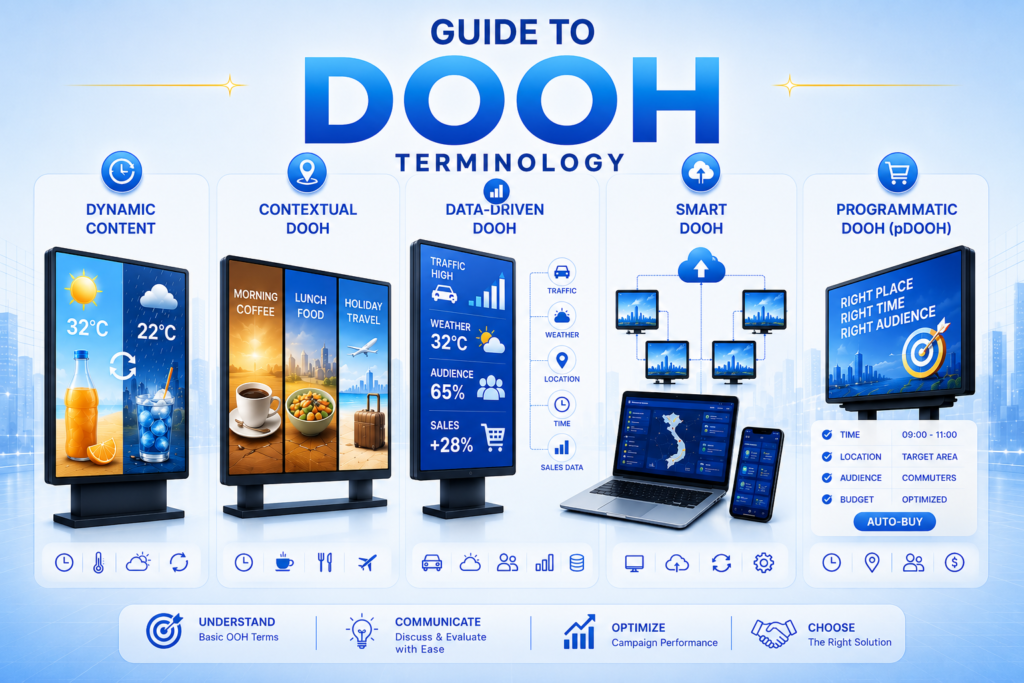
Dynamic Content refers to the ability to change advertising content in real time based on factors such as weather, time, location, data, or events. For example, a beverage advertisement can automatically switch to promoting cold drinks when the outdoor temperature exceeds 35°C.
Contextual DOOH
Contextual DOOH displays advertisements based on the audience’s current context and needs. Examples include coffee advertisements in the morning, food promotions at lunchtime, or travel campaigns before holiday periods to improve relevance and campaign effectiveness.
Data-driven DOOH
Data-driven DOOH is an outdoor advertising model optimized using real-world data. Data sources may include traffic flow, weather conditions, user behavior, location, time, or sales data, enabling brands to make smarter display decisions and improve campaign performance.
Smart DOOH
Smart DOOH refers to intelligent outdoor advertising systems powered by modern technology. These systems enable centralized management, remote content updates, synchronized control of hundreds of screens, operational monitoring, and real-time campaign optimization.
Programmatic DOOH (pDOOH)
Programmatic DOOH (pDOOH) is a method of purchasing DOOH advertising through automated platforms rather than manual scheduling.
Similar to Google Ads or Meta Ads, advertisers can flexibly choose timing, locations, target audiences, budgets, and optimize ad delivery using real-time data. It is widely recognized as one of the most significant trends shaping the global DOOH industry.
6. Creative Content Terminology
Creative
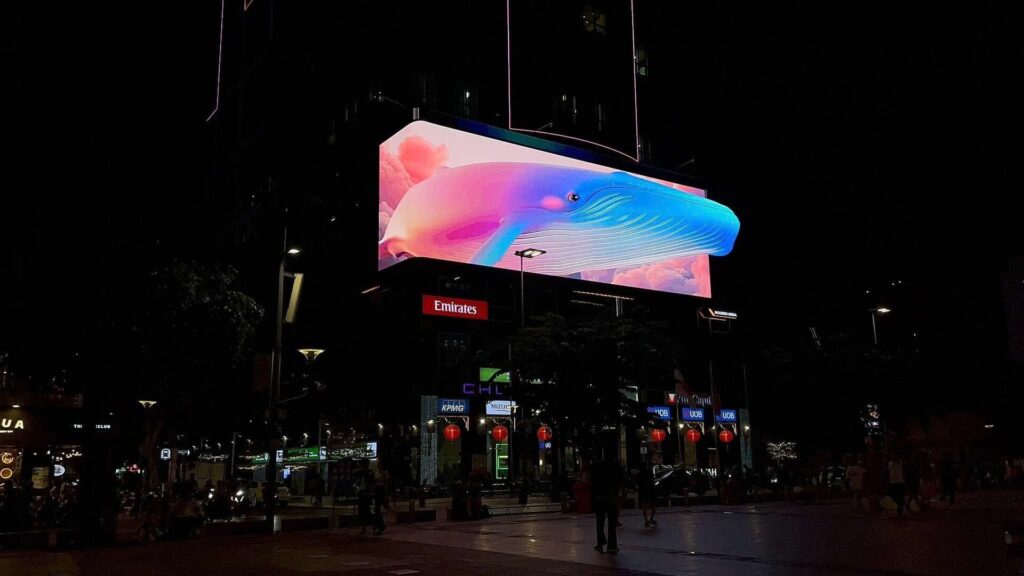
Creative refers to the advertising content displayed on outdoor advertising screens to communicate a brand’s message. Depending on campaign objectives, creative assets may include static images, videos, animations, 3D anamorphic effects, or CGI, helping increase audience attention and brand recall.
CTA (Call-to-Action)
A CTA (Call-to-Action) is a message encouraging viewers to take a specific action after seeing an advertisement, such as scanning a QR code to receive an offer, visiting a website, downloading an app, or registering for a service.
A clear and compelling CTA increases audience engagement and encourages conversion from brand awareness to action.
QR Code Integration
QR Code Integration refers to embedding QR codes into outdoor advertisements, allowing viewers to interact directly with a brand simply by scanning the code.
This solution connects the offline OOH experience with online platforms (OOH-to-Online, or O2O), while also helping businesses measure campaign performance and drive conversions directly at the point of contact.
7. Emerging OOH Industry Terminology
Alongside traditional concepts, the out-of-home advertising industry is introducing new terminology driven by technology and data, including AI-powered DOOH, Real-time Optimization, Audience Measurement, Contextual Targeting, Smart DOOH Ecosystem, Retail Media, Interactive DOOH, and Omnichannel DOOH.
These concepts reflect the transformation of OOH from a reach-focused advertising channel into an intelligent media platform capable of data-driven optimization and deep integration with the digital ecosystem.
Understanding OOH Terminology to Build More Effective Campaigns
A solid understanding of OOH and DOOH terminology enables businesses to select the right advertising solutions, collaborate more effectively with partners, and optimize communication campaigns.
With a comprehensive outdoor advertising ecosystem that includes billboards, LED screens, airport advertising, Metro advertising, and numerous strategic media locations nationwide, Goldsun Media partners with brands throughout every stage of the campaign—from strategic consultation and media planning to execution and optimization—helping businesses reach the right audience and maximize the return on their advertising investment.
Find out more in Part 2 here.