

As consumers are exposed to thousands of messages every day, neuroscience, data, and technology are helping OOH move beyond measuring visibility toward capturing attention, evoking emotions, and leaving a lasting impression in memory.
When “Being Seen” Is No Longer the End Goal
Every day, consumers are exposed to an overwhelming amount of information. In this environment, the brain does not process everything the eyes see. Instead, it constantly filters out stimuli deemed irrelevant to conserve cognitive resources.
This is one of advertising’s greatest challenges: being seen does not mean being noticed.
A billboard may fall within a passerby’s field of vision, but that does not guarantee the message is actually processed by the brain. Similarly, an impression recorded by an advertising system does not necessarily translate into a lasting impression in the consumer’s mind.
The study The Neuroscience of Digital Out-of-Home Advertising Impact by Allvision and Brainsights examines this issue through the lens of neuroscience, highlighting a major shift in the OOH industry: from measuring presence to validating impact.
In other words, the question is no longer simply, “Does the ad appear in front of consumers?” but rather, “Do consumers actually pay attention to, connect with, and remember the message?”
From Impression to Impact: Measuring Real Impressions in OOH
One notable approach highlighted in the study is the SI Score (Seen/Impact Score), a model that separates advertising effectiveness into two dimensions: visibility (Seen) and the level of impact generated (Impact).
In the Seen category, the factors considered include:
- Precise Percentage: The proportion of time the eyes are actually focused on the advertising asset while it is within the useful field of view.
- Average Precise Duration: The average amount of time viewers spend looking at the advertisement.
- Lookback Count: The number of times viewers look back at the advertisement.
Meanwhile, the Impact category delves deeper into the brain’s responses:
- Attention: The level of focus on the message.
- Connection: The level of emotional connection.
- Encoding: The ability to encode information into long-term memory.
- Immersion: The extent to which consumers absorb and internalize the message.
To measure these responses, the study uses methods such as EEG and eye-tracking, rather than relying solely on traditional reach metrics.
This marks a significant shift in how the OOH industry defines an impression: a served impression is not necessarily a viewed impression, and a viewed impression does not necessarily translate into impact.
Size Still Matters – But in a Different Way
For many years, size and location have been considered fundamental factors in OOH. The study’s findings show that the advantage of Digital Large Format lies not only in its ability to create a visually prominent advertising asset, but also in its direct connection to the ability to capture cognitive resources.
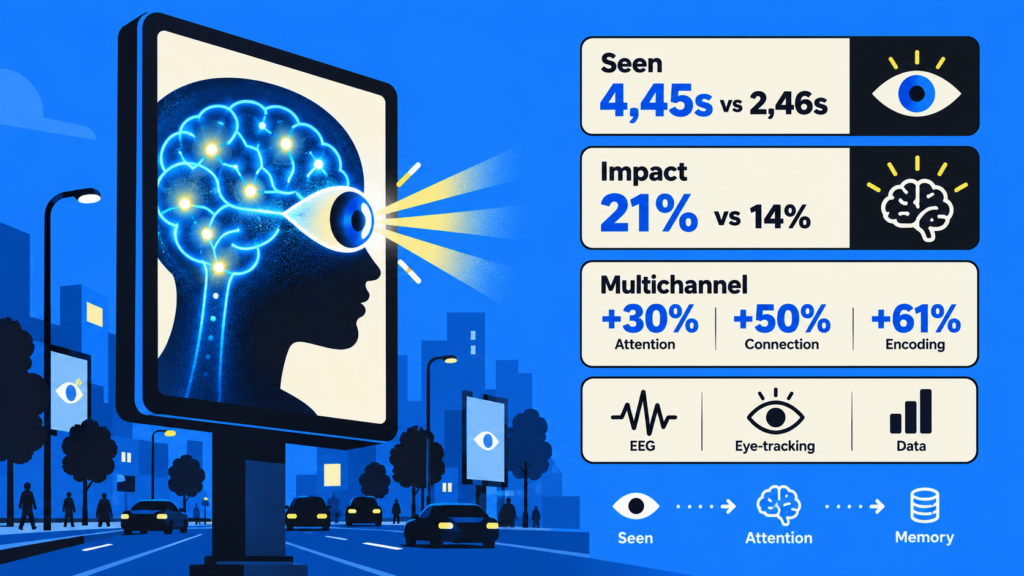
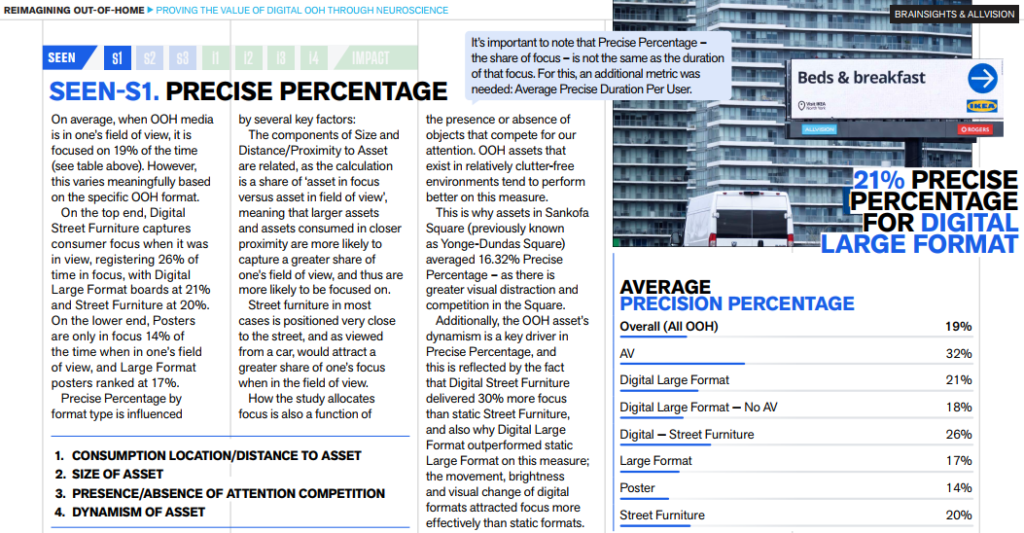
According to the study, Digital Large Format can hold viewers’ gaze for an average of 4.45 seconds, more than 80% longer than the industry-wide average of 2.46 seconds.
The precise attention rate also highlights a clear difference:
- Digital Large Format: 21%
- Conventional Posters: 14%
The advantage of large-format advertising in this context is not simply that it is “bigger.” A large advertising asset in a low-distraction environment can occupy a greater portion of the field of view, reducing visual noise and allowing the brain to prioritize processing the message.
When exposure is sufficiently sustained, Memory Encoding and Emotional Connection may also improve. This suggests that the key question for OOH should go beyond simply asking, “Where are the most people?” and take the next step: “Where can brands capture the highest-quality attention?”
DOOH Is More Than Just a Standalone Channel
Another shift in OOH thinking concerns how DOOH is viewed within the media mix. Rather than treating OOH as a standalone channel, research into cross-channel media combinations shows that DOOH can serve different roles depending on the sequence of exposure.
When consumers are exposed to DOOH before video or audio ads, DOOH can serve as a priming mechanism, preparing them to engage with subsequent messages. According to the study, Attention increases by 8% and Connection by 7%.
Conversely, when OOH follows digital or audio ads, the amplification effect is stronger:
- Attention increases by 30%
- Connection increases by 50%
- Encoding increases by 61%.
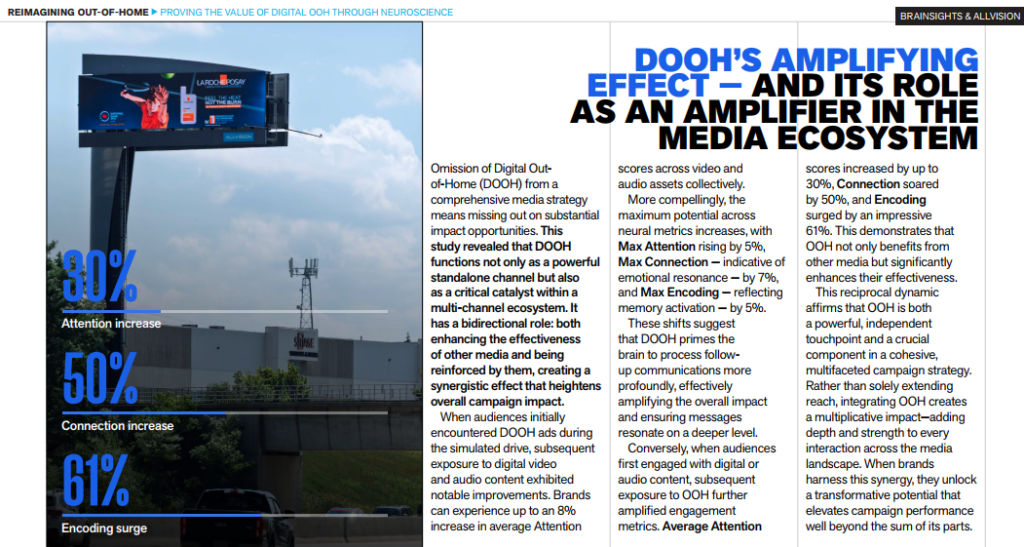
This offers a different perspective on OOH: outdoor advertising does not necessarily have to be the first touchpoint. In a multichannel media journey, it can serve as the final reinforcing touchpoint, helping messages already delivered through personalized channels leave a lasting impression in consumers’ minds.
The “High-Traffic” Paradox: More People Don’t Necessarily Mean Greater Effectiveness
One of the most common assumptions in OOH is that the more foot traffic a location attracts, the greater its advertising value. However, neuroscience introduces another variable to consider: the level of competition for attention.
In areas with a high concentration of LED screens, dozens of messages competing within the same space can create “cognitive noise.” Research conducted at Sankofa Square (Yonge-Dundas Square) found that the precise attention rate was just 16.32%, below the industry-wide average. This reveals a paradox: high traffic does not necessarily translate into high attention.
A location may attract millions of passersby, but if it also faces intense competition from numerous messages, it may not deliver as much value as a less cluttered environment where a brand can capture attention more effectively.
Therefore, alongside familiar metrics such as traffic, reach, and frequency, “clutter” – the level of noise in the media environment – may become an increasingly important factor in OOH location selection.
Vietnam: From DOOH to Programmatic DOOH
These changes are taking place as Vietnam’s market experiences rapid growth in Digital OOH. The Vietnamese DOOH market is growing at a compound annual growth rate (CAGR) of 10.7%, while Digital OOH is projected to account for 62.39% of the total OOH market in 2025.
The development of digital infrastructure, particularly 5G, combined with data connectivity, is creating favorable conditions for the growth of Programmatic DOOH. Notably, this shift goes beyond the transition from static billboards to digital screens. As screens become more flexible to manage and connected to data, OOH is gaining the ability to respond to time, context, location, and audience.
The market study “From Seeing to Acting: How OOH Drives Online Behavior Among Vietnamese Consumers” by Cốc Cốc and Goldsun Media reveals several notable characteristics of Vietnamese users:
- Millennials aged 25–34 devote approximately 50% of their regular attention to OOH.
- In Hanoi and Ho Chi Minh City, approximately 45–49% of viewers see advertisements multiple times a day.
- Locations with high dwell times, such as traffic intersections, busy commercial districts, office buildings, and apartment complexes, remain promising environments for capturing attention.
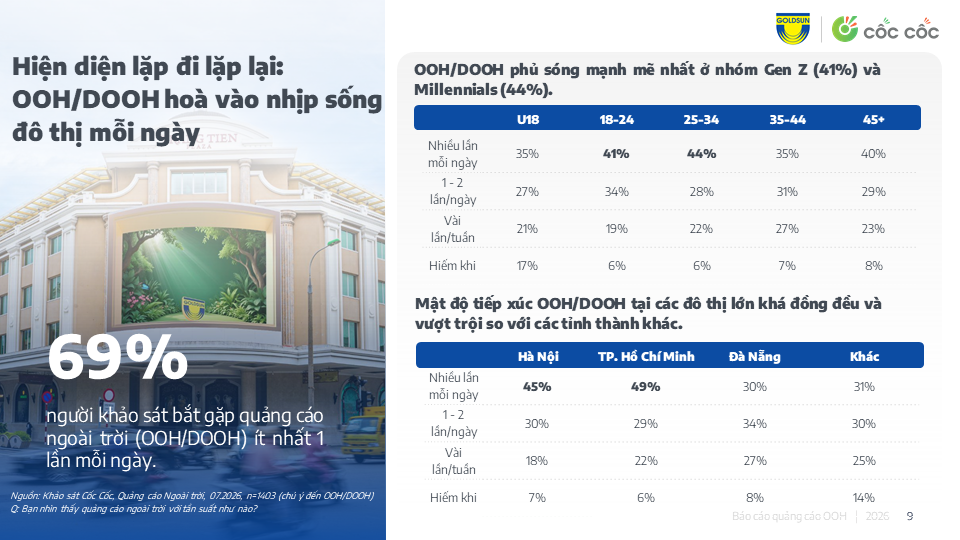
More importantly, when OOH data can be connected to the digital environment, the media journey can extend from offline to online, creating opportunities to re-engage users on their smartphones and establish an O2O loop.
The Future of OOH Is Not About Being Seen More
The development of neuroscience, data, and DOOH is prompting a shift in how the out-of-home advertising industry thinks about effectiveness. In the past, the key questions may have been: How many people pass by? How many impressions are generated? How often does the ad appear? These questions still matter, but they may not be enough to answer the most important one: Does the ad truly leave a lasting impression in consumers’ minds?
From Seen to Impact, from Impression to Attention, and from individual billboards to a multichannel media ecosystem, OOH is increasingly being recognized as a platform capable of shaping consumer cognition, rather than simply serving as a space for displaying ads.
As attention becomes one of the scarcest resources among consumers, the future value of an OOH asset may depend not only on how many people see it, but also on how many truly pause, feel, and remember. The next stage of competition in OOH, therefore, will not be just a race for reach. It will be a race to capture attention and create “memorable impressions.”
Read the Full Report: “From Seeing to Acting: How OOH Drives Online Behavior Among Vietnamese Consumers”