Goldsun Media, in collaboration with Cốc Cốc, officially releases the report “The Role of Out-of-Home Advertising in the Real Estate Research and Selection Journey,” providing in-depth insights into how OOH/DOOH influences attention, trust, and information-seeking behavior among real estate buyers in Vietnam.
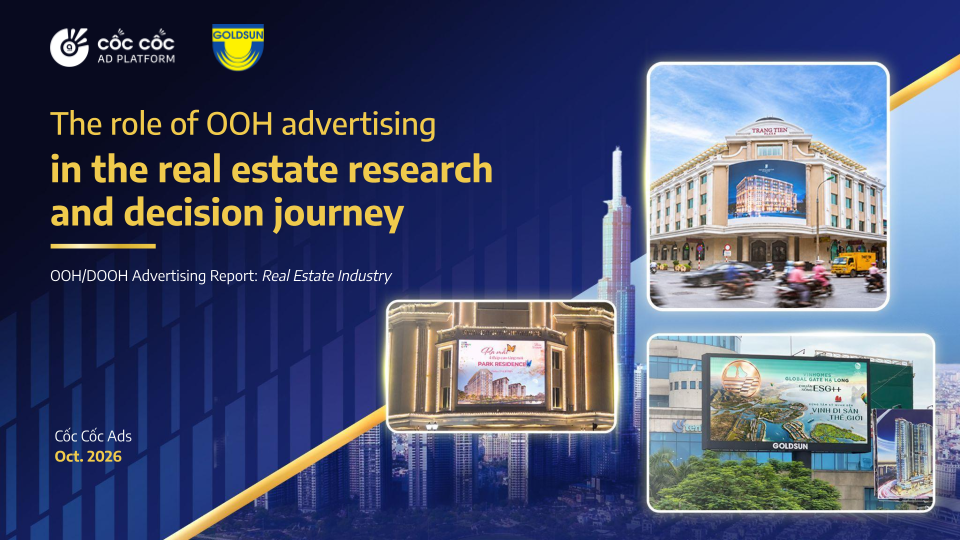
Real estate represents one of the most significant financial decisions for Vietnamese consumers, often involving a lengthy consideration process. Throughout this journey, out-of-home advertising appears at familiar touchpoints such as shopping malls, major roads, intersections, and areas near property developments, helping bring real estate imagery and information closer to potential buyers.
Continuing their series of in-depth studies on out-of-home advertising, Goldsun Media and Cốc Cốc have conducted a new report to measure the role of OOH/DOOH throughout the journey from attention and recall to trust-building, online search, and property consideration.
Combining Consumer Data with Real-World OOH Market Data
The report is based on an online survey conducted in October 2026 with 1,684 respondents aged 18 and above, combined with data from Cốc Cốc’s ecosystem of 30.5 million users and Goldsun Media’s advertising monitoring data across its urban and airport LED networks from January to October 2026.
Among the survey participants, 885 respondents reported paying attention to real estate OOH/DOOH advertising, while 799 respondents paid little or no attention to this advertising format.
Goldsun Media’s monitoring data shows that real estate is currently the third-largest advertising category on outdoor LED screens nationwide, accounting for 9% of total advertising appearances. Notably, real estate ranks first among advertising categories in Hanoi, with a 12% share, while in Ho Chi Minh City, it ranks third at 8%.
OOH Not Only Builds Awareness but Also Helps Establish Trust
One of the report’s key findings highlights the role of OOH in shaping perceptions of a project’s scale and credibility.
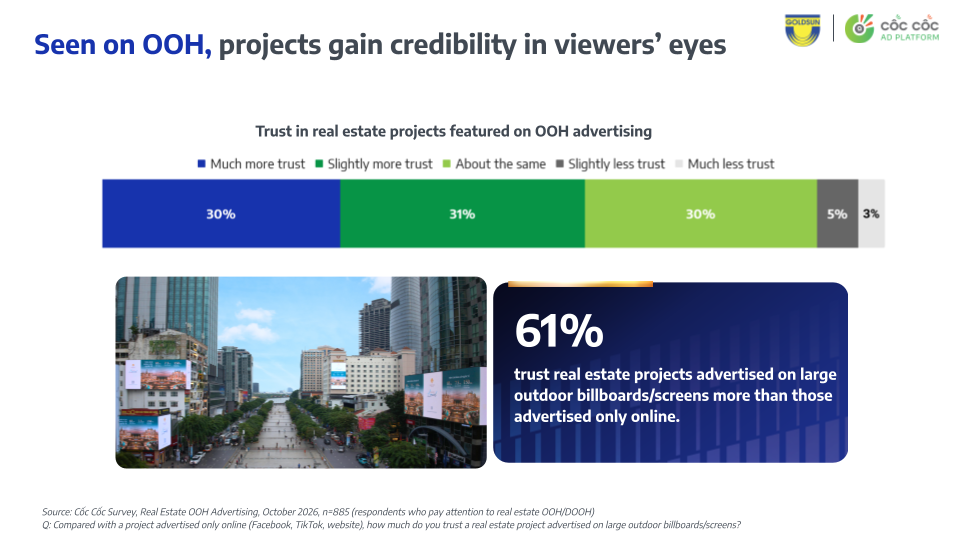
According to the survey, 61% of respondents who pay attention to real estate outdoor advertising said they have greater trust in projects advertised on large-format outdoor billboards or screens compared to those promoted exclusively through online channels.
When comparing two projects with equivalent information on pricing, location, and amenities, 71% of respondents were more inclined toward the project that appeared more frequently in outdoor advertising.
Large-format OOH also helps reinforce multiple layers of perception, from brand recall and project scale to developer capabilities and market interest.
In terms of advertising formats, 46% of respondents who pay attention to real estate OOH identified large-format outdoor LED screens as the most attention-grabbing and memorable format, outperforming indoor screens, project signage, static billboards, and transit advertising.
From OOH to Search: The Journey Continues Online
The report also reveals a clear connection between outdoor advertising touchpoints and online behavior.
Among respondents who pay attention to real estate OOH, 88% took at least one action after seeing a sufficiently impactful advertisement. Specifically, 41% remembered the project or developer’s name for later research, 32% took photos of the advertisement, and 30% immediately searched for information on their phones.
Notably, among those who took at least one action after seeing an OOH advertisement, 96% reported having subsequently searched online for information about the project or developer.
This behavior occurs relatively quickly: 55% of those who conducted further searches did so on the same day they saw the advertisement.
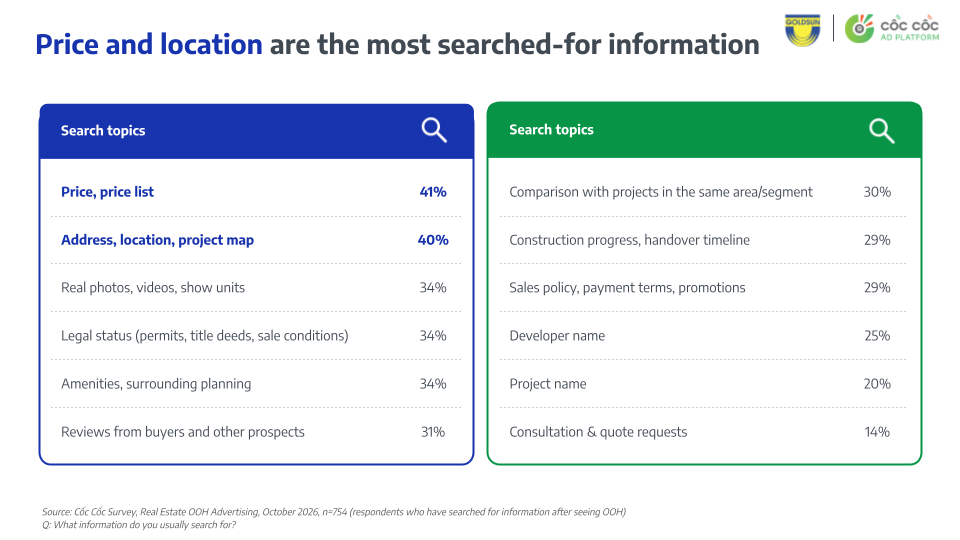
The most sought-after information following OOH exposure includes selling prices and price lists (41%), project locations and maps (40%), followed by actual project images, legal information, and project amenities (34% each).
Exploring New Approaches to Real Estate Advertising
Beyond its ability to capture attention and build trust, the research also indicates that audiences increasingly expect real estate advertising to be more transparent and informative.
Looking ahead, 34% of survey respondents want advertisements to provide clear pricing, sales policies, and promotional offers; 33% prioritize transparent legal information; and 30% prefer minimalist designs with concise messages that are easy to read while on the move.
These findings suggest that the effectiveness of real estate OOH/DOOH advertising goes beyond achieving visibility on a large scale. Brands need to align the right audience, location, creative, and search intent, ensuring that every outdoor touchpoint not only creates a lasting impression but also provides sufficient information cues to encourage audiences to continue their research online.
Through the report “The Role of Out-of-Home Advertising in the Real Estate Research and Selection Journey,” Goldsun Media and Cốc Cốc aim to provide an additional data resource for developers, brands, and media agencies in planning their OOH/DOOH strategies, particularly as real estate decision-making journeys increasingly unfold across both physical and digital environments.