Fast-moving consumer goods (FMCG) represent the product category with the highest purchase frequency among Vietnamese households, while also accounting for the most extensive presence across out-of-home advertising networks in key urban areas. Following the August 2026 report “From Exposure to Action: How OOH Drives Vietnamese Consumers’ Online Behavior,” Goldsun Media, in collaboration with Cốc Cốc, conducted an in-depth study to comprehensively assess the role of traditional out-of-home (OOH) and digital out-of-home (DOOH) advertising. Published in early October 2026, the report “The Role of Out-of-Home Advertising in the FMCG Shopping Journey” measures the impact of these media channels across key touchpoints throughout the FMCG shopping journey — from exposure and ad recall to triggering online search behavior, driving purchase intent, and ultimately influencing impulse purchase decisions at the point of sale. The findings provide a strategic data foundation for FMCG businesses to plan their media budgets and optimize the effectiveness of their OOH advertising investments.
FMCG Category Presence and Media Priority on OOH/DOOH
On the urban media landscape, the FMCG category holds a dominant position in terms of presence across digital out-of-home (DOOH) screen networks. The high frequency of repeat purchases, coupled with intense competition for market share, requires FMCG brands to maintain a consistent presence in consumers’ minds, making OOH/DOOH a strategic tool for commanding mass visual attention.
According to the report, the FMCG category maintains the leading share of media visibility both nationwide and across key urban markets.
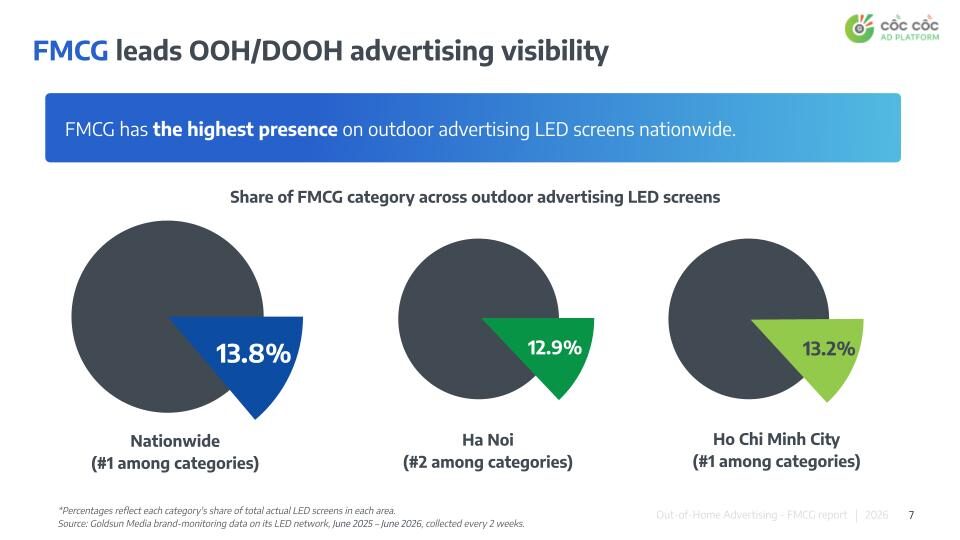
The distribution of display frequency across FMCG product categories closely reflects the media budget priorities of major brands. The ranking below, from 1 to 8, summarizes the prevalence of each product category across OOH/DOOH networks:
The dominance of beverages (soft drinks, beer and spirits) and packaged foods (snacks, instant noodles) on the OOH/DOOH channel is not coincidental, but stems from the characteristics of consumer behavior: these are products with low purchase values, for which purchase decisions are made quickly and are highly spontaneous and impulsive. At the same time, these categories have an extremely dense distribution network, ranging from convenience stores and traditional grocery stores to supermarkets. OOH/DOOH advertising plays the role of a “trigger” that stimulates immediate appetite and demand when consumers are on the move, thereby minimizing the distance between brand awareness and the behavior of visiting the nearest point of sale to make a purchase.
This impulse purchase stimulation effect is strongly reinforced by the repetition mechanism of advertising exposure frequency.
Relationship Between OOH/DOOH Advertising Exposure Frequency and FMCG Purchase Frequency
In communication and consumer behavior theory, exposure frequency plays a fundamental role in reinforcing long-term memory. The research team found that the cumulative effect of daily exposure to out-of-home advertising creates a natural reminder mechanism that continuously influences the subconscious and drives the recurring cycle of FMCG purchasing behavior.
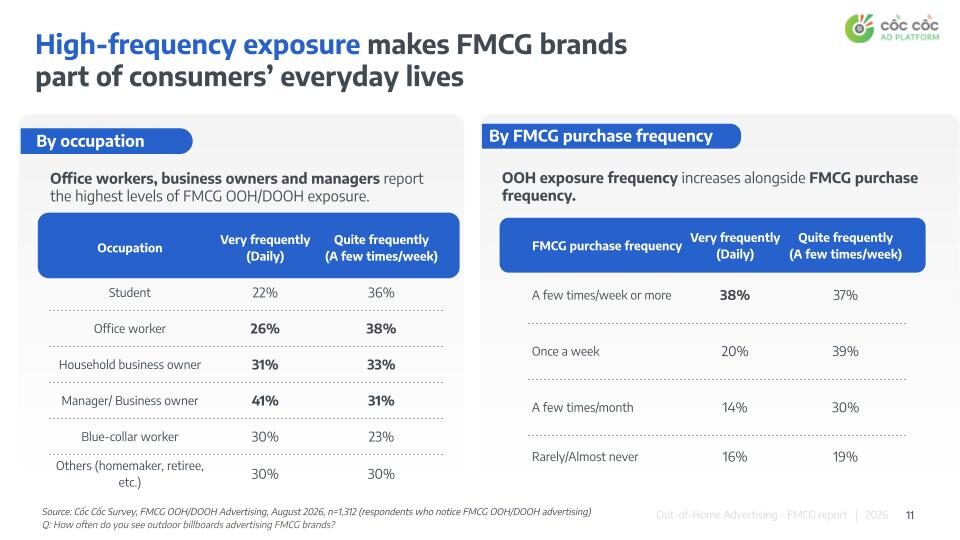
The analysis of the research data clearly confirms the following finding: “The higher the frequency of exposure to advertising, the more frequently consumers purchase FMCG products.” This relationship is clearly demonstrated through a detailed analysis of the exposure groups:
- Very Frequent Advertising Exposure Group (Daily): As many as 38% of respondents purchase FMCG products several times a week or more; 20% purchase approximately once a week; 14% purchase several times a month; and 16% rarely or almost never make such purchases.
- Fairly Frequent Advertising Exposure Group (Several Times a Week): 37% of respondents purchase FMCG products several times a week or more; 39% purchase approximately once a week; 30% purchase several times a month; and 19% rarely or almost never make such purchases.
When the two groups above are combined into the High Frequency Exposure Group (including consumers exposed to advertising daily + several times a week), the data reveals a clear behavioral pattern: 58% to 76% of consumers who are frequently exposed to OOH/DOOH advertising make FMCG purchases at least once a week or more (with the group purchasing several times a week consistently accounting for the largest share at approximately 38%). This demonstrates that maintaining a continuous presence across the streets helps nurture consumers’ regular purchasing habits, providing a strong rationale for Media Planners to protect budgets for long-term Always-on campaigns and sustain Share of Voice (SOV).
By occupational segment, daily exposure to OOH/DOOH advertising shows notable differences:
- Managers/Business Owners: The highest exposure rate, with 41% reporting very frequent exposure (daily) and 31% reporting fairly frequent exposure (several times a week).
- Business Households: 31% reporting very frequent exposure and 33% reporting fairly frequent exposure.
- Workers: 30% reporting very frequent exposure and 23% reporting fairly frequent exposure.
- Other (homemakers, retirees, etc.): 30% reporting very frequent exposure and 30% reporting fairly frequent exposure.
- Office Workers: 26% reporting very frequent exposure and 38% reporting fairly frequent exposure.
- Students: 22% reporting very frequent exposure and 36% reporting fairly frequent exposure.
The most strategic finding lies in the fact that the audience segments with higher income levels and primary decision-making power over household spending (Managers/Business Owners, with 41% exposed daily, and Business Households, with 31%) are also the groups with the highest frequency of OOH/DOOH exposure, driven by their continuous mobility for business and commercial activities. This presents a valuable opportunity for premium FMCG brands or large-scale household consumer product packages. High exposure frequency among these audiences serves as a direct lever to convert awareness into revenue with high lifetime value (LTV).
To optimize exposure frequency for each specific audience segment, accurately identifying the optimal locations and “golden” time slots for ad placements is a critical requirement.
Golden Touchpoints: Strategic Time Slots and Locations for Audience Reach
For an FMCG OOH/DOOH campaign to achieve optimal conversion performance, broad coverage alone is not enough; businesses need to precisely identify the “Golden Touchpoints” — where consumers’ travel environments intersect with moments when they are psychologically receptive to advertising messages, thereby triggering emerging purchase needs.
Analysis of the data by time of day shows the dominance of commuting hours, while also revealing clear age-based differences across the Top 3 time slots that attract the most attention:
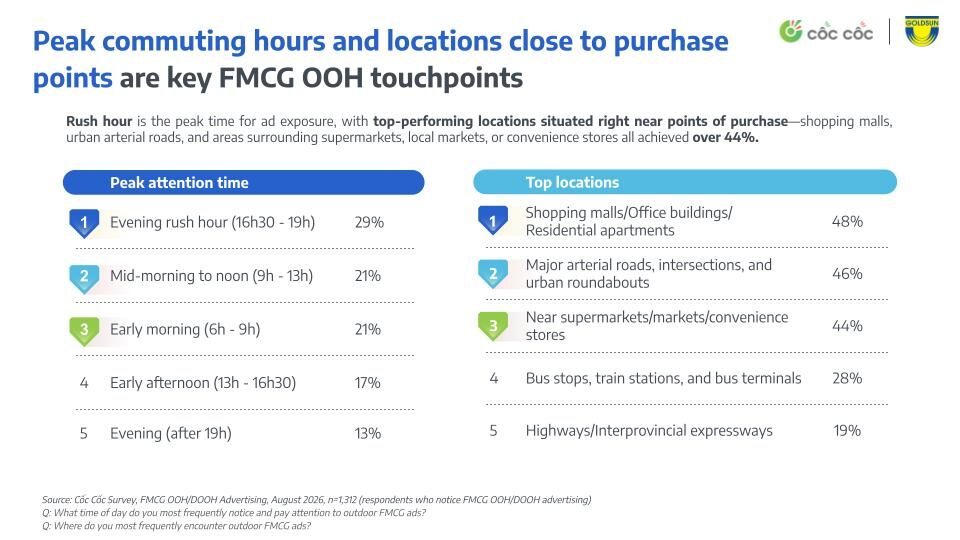
The detailed matrix showing age-based differences across the Top 3 time slots attracting the most attention is summarized as follows:
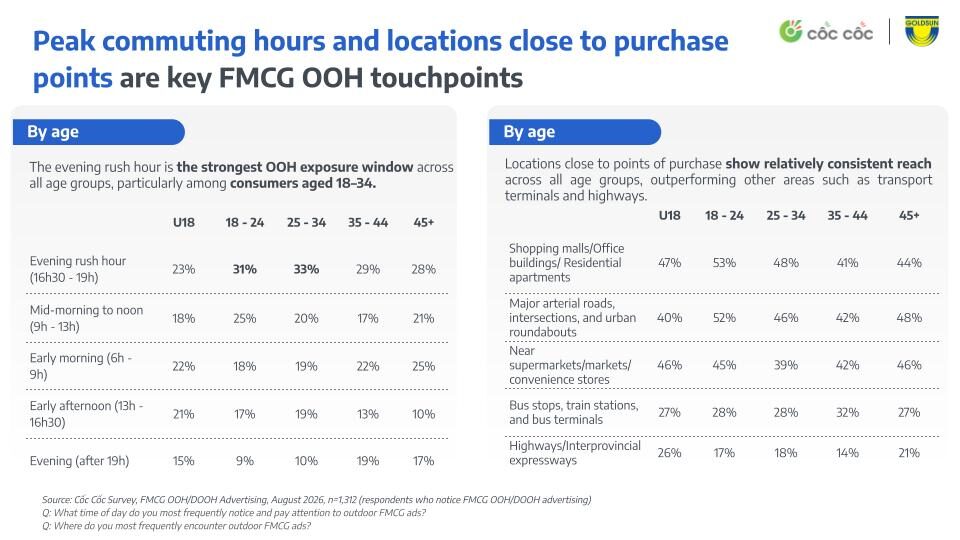
From a spatial perspective, the location of an advertising billboard also directly determines its ability to attract attention and the distance to purchase behavior.
A clear alignment between space and time can be observed: the Top 3 leading advertising locations all record exceptionally high attention rates and are located within very close proximity to where people live or shop. When FMCG advertising appears at the right moment as consumers travel from work to home during commuting hours (16:30 – 19:00) at locations close to points of sale (markets, supermarkets, convenience stores, residential buildings), the buffer between “seeing the advertisement” and “taking action to make an impulse purchase” is almost completely eliminated.
Chiến lược cho chuyên gia marketing FMCG
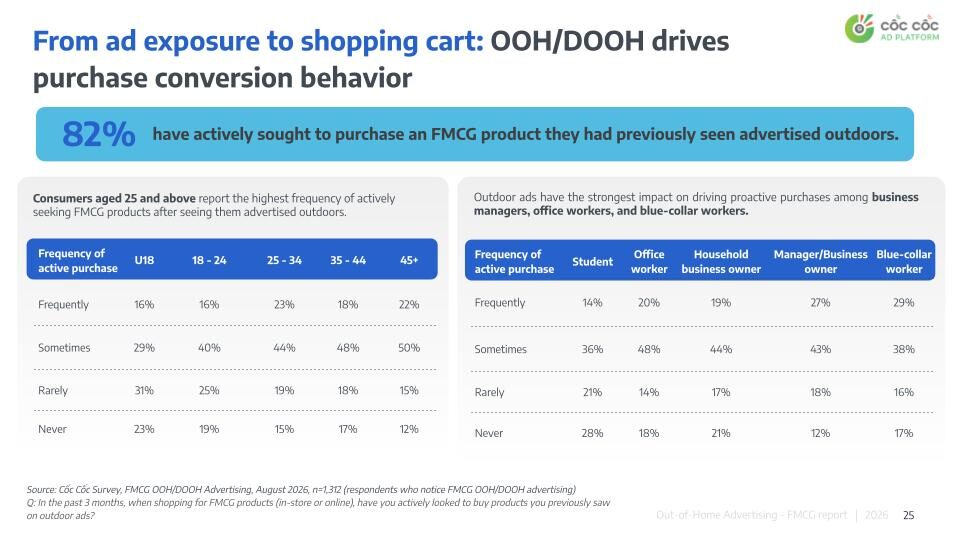
Based on data analysis by Cốc Cốc Research and Goldsun Media, it can be affirmed that OOH/DOOH is no longer merely a channel for enhancing brand awareness, but has become a tool for shaping and stimulating consumer purchasing behavior throughout the consumer journey. To translate these market insights into a tangible competitive advantage and optimize investment costs, FMCG Marketing professionals should focus on implementing the following three strategic actions:
1. Optimize display locations based on proximity to points of sale: Prioritize budgets for LED screens/billboards located in close proximity to shopping malls, supermarkets, markets, convenience stores, and residential/office complexes to trigger impulse purchases directly at the point of sale.
2. Develop smart scheduling based on golden time slots: Increase advertising frequency during the afternoon commuting hours (16:30-19:00) to maximize reach among the core 18-34 audience on their way home, while flexibly adding early morning time slots (06:00-09:00) if the target audience is mature households (45+).
3. Keep messaging concise and focused on beverages and food: Leverage the strong media presence of the beverage and packaged food categories to deliver compelling messages that stimulate appetite and prompt immediate purchase decisions while consumers are on the move.