When are consumers most attentive to FMCG advertising? Which locations create the most effective touchpoints? And is frequent exposure to advertising associated with purchase frequency? The market research study “The Role of Out-of-Home Advertising in the FMCG Shopping Journey,” conducted by Cốc Cốc and Goldsun Media, reveals notable findings that highlight the conversion potential of out-of-home (OOH/DOOH) advertising for the fast-moving consumer goods (FMCG) sector.
FMCG – Leading Category in Out-of-Home Advertising Coverage
Within the broader out-of-home advertising landscape, fast-moving consumer goods (FMCG) have established a dominant position, becoming the category with the highest share of visibility across outdoor LED screen networks nationwide.
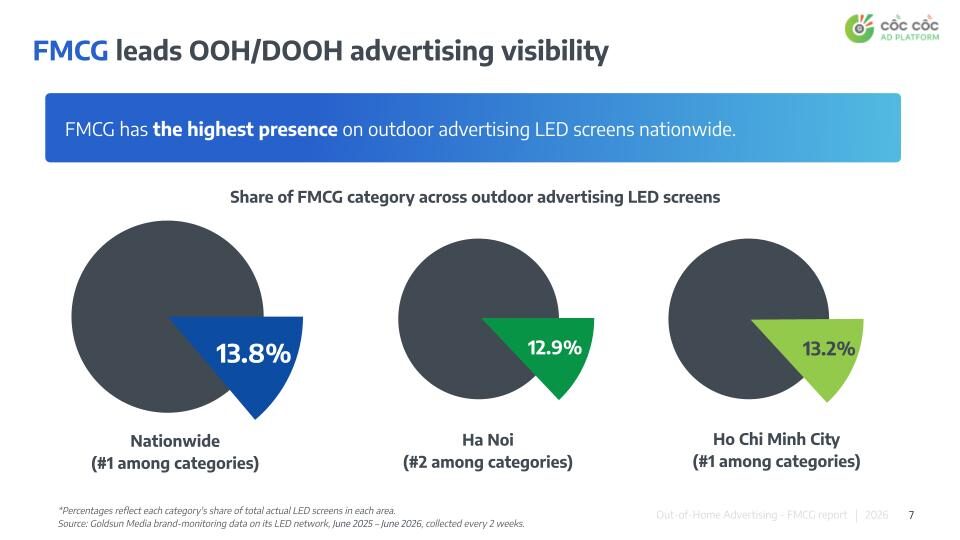
As the product category with the highest household purchase frequency, the FMCG market is fundamentally a battle to maintain continuous brand recall. Major FMCG brands are willing to invest heavily in out-of-home advertising space to consistently maintain a strong presence in consumers’ minds.
“In the race to capture FMCG consumers’ attention and stay top of mind, out-of-home advertising is no longer a secondary option, but has become a leading strategic media channel.”
Timing and Location: Decisive Touchpoints
The effectiveness of OOH/DOOH advertising depends not only on display size, but also heavily on identifying the right “golden time” and “golden locations” when consumers’ natural purchase needs arise.
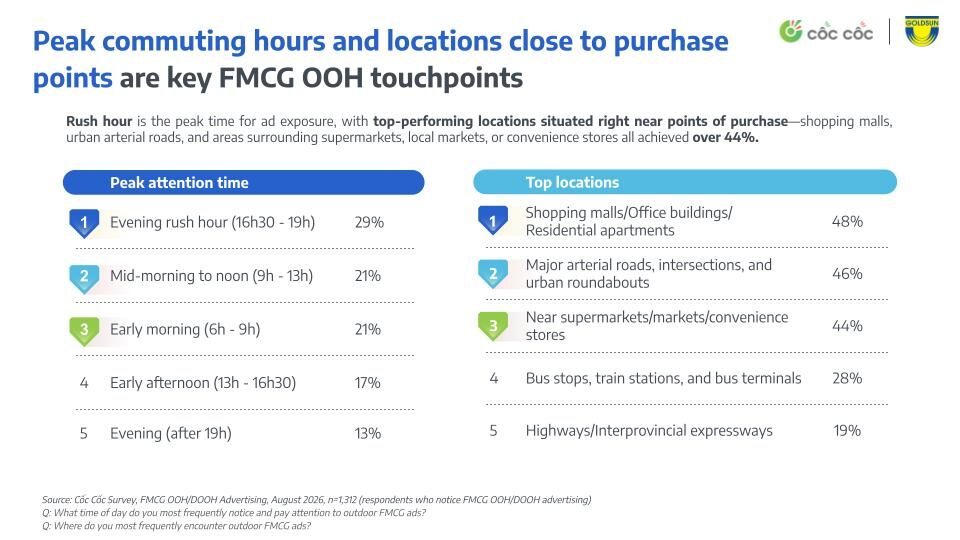
- Peak Attention Time: The afternoon rush hour (16:30-19:00) records the highest level of attention at 29%. This rate is particularly high among younger, active audiences, reaching 31% among those aged 18-24 and 33% among those aged 25-34. Attention is evenly distributed at 21% across other time slots, including late morning to noon (09:00-13:00) and early morning (06:00-09:00).
- Top Attention Locations: Spaces located near points of purchase or along high-traffic routes record the highest attention rates:
Shopping malls / office buildings / residential complexes: 48%
Major roads / intersections / roundabouts in urban areas: 46%
Areas near supermarkets / markets / convenience stores: 44%
The fatigue and hunger consumers experience after work, combined with advertising placements located directly along routes leading to supermarkets or convenience stores, create the “trigger” that turns physical proximity into an immediate opportunity to activate emerging purchase needs.
However, getting the timing and location right is only half of the conversion equation. To truly turn “a glance on the street” into “a purchase,” brands must also address the frequency of message repetition to build strong and lasting brand recall in consumers’ minds.
More Exposure, More Frequent Purchases: The Power of Message Repetition
The market research study “The Role of Out-of-Home Advertising in the FMCG Shopping Journey,” conducted by Cốc Cốc and Goldsun Media, reveals a clear positive relationship between the frequency of out-of-home advertising exposure and how frequently consumers purchase FMCG products.
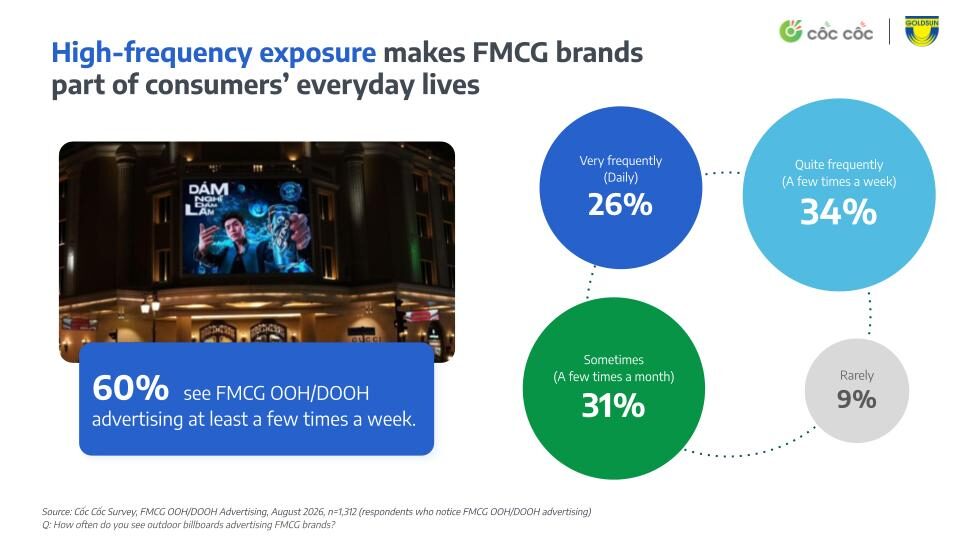
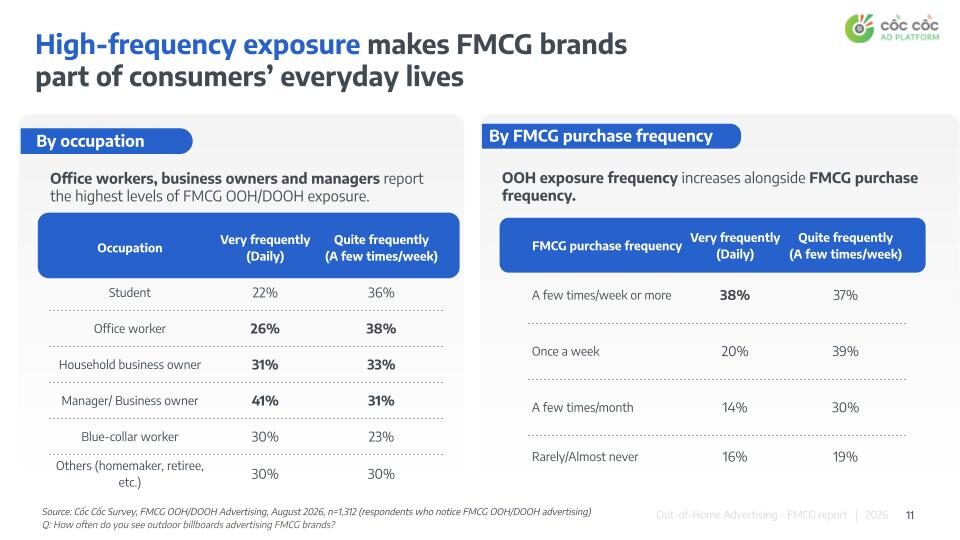
- Frequency Relationship: Among consumers who purchase FMCG products several times a week or more, 38% see FMCG OOH/DOOH advertising very frequently (daily), while 37% see it fairly frequently (several times a week).
- Exposure Breakdown by Occupation:
The groups with the highest frequency of seeing advertising daily are Managers/Business Owners (41%), followed by Household Businesses (31%) and Workers (30%).
Among office workers, while the daily exposure rate stands at 26%, the group records a fairly frequent exposure rate (several times a week) of as high as 38% – reflecting highly consistent travel patterns and exposure to visual messages throughout the working week.
The ”little by little” effect of OOH/DOOH builds familiarity over time. Repeated exposure to product imagery throughout consumers’ daily journeys significantly reduces consideration barriers, encouraging them to make purchase decisions much faster when standing in front of the shelf.
Optimizing OOH/DOOH Channels in FMCG Media Campaigns
Out-of-home advertising (OOH/DOOH) is no longer merely a passive tool for brand positioning. For the fast-moving consumer goods (FMCG) sector, it is increasingly becoming a key link in activating direct purchase behavior through a dual impact: choosing the right “high-intent” moments (afternoon rush hours) and “golden” locations in close proximity to points of sale. To turn this potential into actual sales, FMCG marketers should consider the following strategic actions:
- Optimize Creative Content by Context: Develop tailored visual messages for afternoon rush hours (e.g., tapping into immediate needs for refreshment and an energy boost).
- Close the Consumer Journey: Closely integrate impactful LED screen displays with immediate activation solutions (QR codes for offers, sampling booths, or promotional programs) at nearby points of sale.